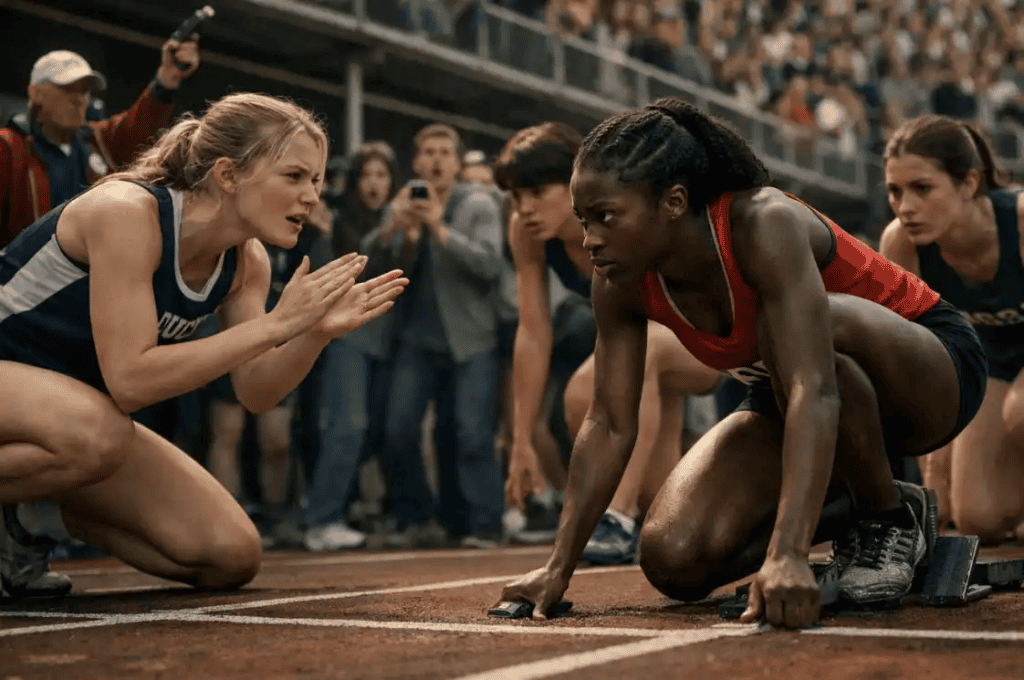
She mocked the girl in old shoes before the race even started.
Not in a hallway.
Not behind her back.
Right there on the 100-meter line, under the stadium lights, with parents in the bleachers and phones already pointed at the track.
The white bully laughed, looked my teammate Nia up and down, and said, “Those spikes look dead. And honestly? So does your shot.”
A few people turned.
Then she went lower.
“You’re too big for sprinting,” she said. “And this isn’t a charity meet.”
Nia didn’t move.
That’s what made it worse.
When cruel people don’t get a reaction, they get louder.
The stadium at Jefferson High was packed that night. It was the state qualifying championship. Bands were playing between events. Parents were waving school colors. Scouts were scattered through the stands with clipboards and sunglasses and that look they always had, like one race could change somebody’s life.
For Nia, it could.
She had spent three years running before sunrise, lifting after class, and training on a cracked public track because her mom worked double shifts and couldn’t drive her across town to the private club where the rich kids trained.
She didn’t have custom spikes.
She didn’t have a nutritionist.
She didn’t have a social media page full of highlight reels.
What she had was lungs, discipline, and terrifying speed.
The bully knew that.
That was the real reason she kept attacking.
Her name was Ashley Mercer. Blonde ponytail. Sponsor-brand spikes. Private sprint coach. Dad on the booster board. The kind of girl who acted like the whole school was a stage built for her.
She had been picking at Nia all season.
Little comments at first.
“Those shoes still alive?”
“You sure you’re in the right event?”
Then came the body comments.
Then the race comments.
Then the ugly little remarks that always danced near race without saying the ugliest word out loud.
Just enough to wound.
Just enough to deny later.
That night, she stopped pretending.
At the starting line, Ashley clapped right in Nia’s face.
“Hope you can keep up,” she said loudly. “Or is that lane just decorative?”
Some boys behind the fence laughed.
One girl muttered, “That’s messed up.”
Ashley smirked, then leaned in closer.
“So many people get opportunities they didn’t earn,” she whispered. “Tonight fixes that.”
I was standing near the relay zone, close enough to see Nia’s expression change.
Not break.
Change.
She went still.
That scary kind of still.
Like a door shut inside her.
Her coach stepped forward, ready to say something, but Nia gave the smallest shake of her head.
No scene.
No shouting match.
No tears for the crowd.
Just focus.
The starter called the runners to their marks.
Eight girls stepped in.
The whole stadium seemed to inhale at once.
Parents lifted phones.
A Stanford scout in a navy windbreaker leaned forward in the second row.
The pistol went up.
“Set.”
Then the shot cracked through the air.
Ashley came out hard.
Nia came out harder.
Not fast.
Violent.
Clean.
Explosive.
By 20 meters, Ashley’s face had changed.
By 40 meters, the crowd was already yelling.
By 60 meters, nobody was looking at anyone else.
By 80 meters, the whole stadium was on its feet.
And by the time Nia crossed the finish line, it felt like the air had been ripped open.
The scoreboard took a second to update.
That second felt like forever.
Then the time flashed.
A stadium record.
A state record.
And then, after officials confirmed wind conditions and timing, the announcer’s voice cracked over the speakers with the kind of disbelief you only hear when history interrupts the script.
“Ladies and gentlemen… that is a new national youth record.”
The place exploded. 😱
People screamed.
Parents cried.
Teammates ran onto the edge of the track before getting waved back.
The same kids who had laughed at her shoes were now staring at Nia like they had just watched a superhero step out of a human body.
Ashley stumbled across the line behind the leaders, not even close.
Not second.
Not third.
Just there.
A background character in somebody else’s miracle.
But that should have been enough.
It wasn’t.
Because while the crowd was losing its mind over Nia’s time, three phones had already captured Ashley’s little performance before the gun.
And one of those phones belonged to the assistant athletic director.
Another belonged to the mother of a freshman runner.
The third belonged to a local reporter covering the championship.
That mattered because our district had a code of conduct every athlete signed.
So did every parent.
And the athletic handbook was painfully clear: harassment based on race, body-shaming, and conduct that targeted another athlete in a public competition could trigger immediate suspension, loss of captaincy, and removal from postseason events.
Ashley thought money would cushion her.
It usually had.
But rules get very sharp when everybody has video.
That night, the clips started spreading through group chats before the medals were even handed out.
By the time athletes were called to the podium, Ashley’s own coach wouldn’t look at her.
By the time Nia stood on the top step, the Stanford scout had already spoken to her coach.
By the time families reached the parking lot, the district office had been emailed three separate videos, each from a different angle, plus a written complaint signed by two parents and one official.
Nia still didn’t say much.
That was the part that got me.
She didn’t chase Ashley down.
She didn’t scream.
She didn’t brag.
She stood there with her medal around her neck and those beat-up spikes still on her feet while reporters crowded closer.
One asked, “Did you hear what the other runner said before the race?”
Nia looked at the camera for a second.
Then she said, “I heard enough.”
That answer went everywhere.
The next morning, the district opened a formal review.
Ashley tried the usual defense.
She said it was “trash talk.”
She said people were “too sensitive.”
Her father called it a misunderstanding.
But video is a terrible thing for entitled people.
It preserves tone.
Facial expression.
Timing.
Intent.
And when three videos match, lies start dying fast. 🤯
The review panel found that Ashley had violated the district athlete conduct policy, the anti-harassment policy, and meet sportsmanship rules.
She lost her captaincy.
She was suspended from the rest of the season.
Her school pulled her from the regional relay team.
One of her brand sponsors quietly removed her from a youth campaign two days later.
Then came the part nobody expected.
A college that had been “very interested” in Ashley announced it was reevaluating her recruitment.
Not because she lost.
Because of the conduct report.
Because no coach building a team wants a runner who humiliates other athletes on camera and then blames the people who got hurt.
Meanwhile, Stanford moved fast.
The scout had already known Nia’s numbers.
But after that race, and after seeing how she handled the spotlight without turning cruel, they offered a full scholarship.
Full ride.
Tuition.
Housing.
Training.
Everything.
I still remember Nia’s mother sitting in the kitchen when the call came. She had one hand over her mouth and the other gripping the counter like the room had tilted. She cried the kind of cry that comes from carrying too much for too long.
Nia cried too.
Quietly.
Like she didn’t want to scare the moment away.
A week later, the school held an assembly about sportsmanship. Funny how institutions discover morality once video exists.
Ashley sat in the front row with her parents.
No applause followed her name.
No whispers of support.
Just that heavy silence people wear when they finally understand the crowd has turned.
Nia got called up after.
The principal talked about resilience.
The coach talked about discipline.
But Nia only said one thing that anyone remembered.
“Don’t mistake quiet for weakness.”
That line hit the room like a hammer.
Because everybody knew exactly who it was for.
And that should have been the ending.
But the best part came after.
Nia donated her old spikes to the school trophy case.
Not because they were pretty.
Not because they were famous.
Because they told the truth.
You do not need polished shoes to run past small people.
You just need a lane.
Ashley finished the year in silence.
No captain patch.
No spotlight.
No easy excuses.
People didn’t destroy her life.
She did that herself the moment she decided humiliation was a personality trait.
Nia finished the year with a record, a scholarship, and a whole stadium forced to confront what they had almost ignored.
A girl they underestimated.
A bully they tolerated too long.
And a line between confidence and cruelty that should have been obvious from the start. 💔➡️✨
So I’ll say it plain:
If you stand with discipline, dignity, and earned victory, share this.
If you think public cruelty deserves public consequences, stand with Nia.
No middle ground.
No excuses.
Team NIA or Team NO CONSEQUENCES — pick one. 👇