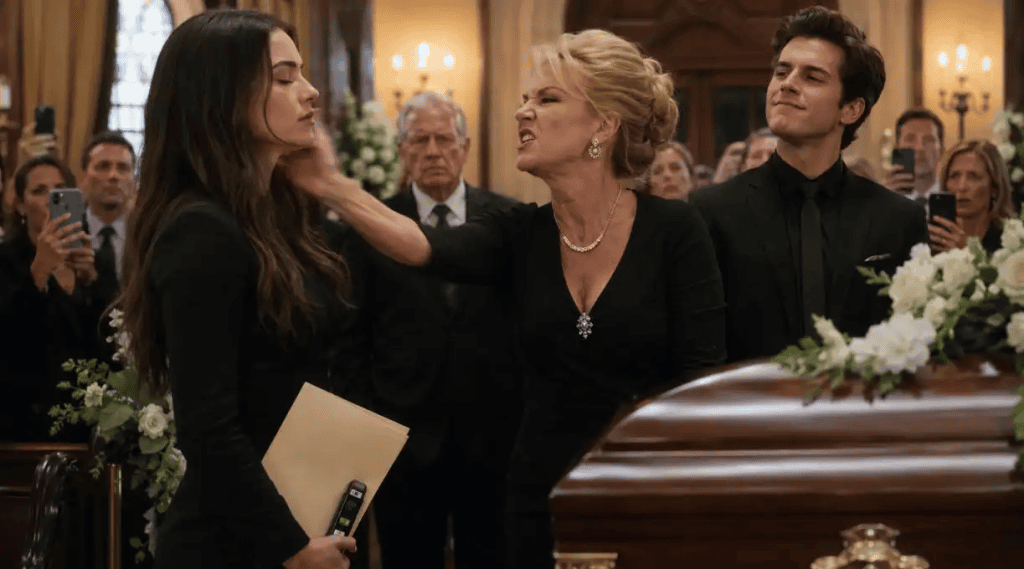
The chapel speakers crackled again.
My father’s voice filled the room.
Not weak.
Not confused.
Not the voice Margaret had described for months.
Clear.
Steady.
Angry.
“If you’re hearing this, Margaret…” my father said, “then you did exactly what I knew you would do.”
The entire chapel went silent.
Margaret’s hand was still in the air from slapping me.
Her boyfriend, Victor, slowly removed his hand from her waist.
My cheek throbbed.
But I did not move.
Not yet.
Because my father had told me exactly how this day would go.
Six months before his funeral, he called me to the old greenhouse behind the estate.
That place had been my mother’s favorite.
After she died, I was the only one who still watered her roses.
Margaret hated that.
She hated the greenhouse.
She hated the portraits.
She hated the family employees who remembered my mother’s name.
Most of all, she hated me.
I was the oldest daughter.
The one who knew the company books.
The one who knew where my father kept the original trust documents.
The one person who could not be charmed by her perfume, her fake tears, or her soft little speeches about “starting fresh.”
To the outside world, Margaret was elegant.
A grieving wife.
A woman who married an older widower and “saved him from loneliness.”
To me, she was the woman who slowly moved my father’s loyal staff out of the house.
One by one.
The driver.
The night nurse.
The cook.
Then she tried to move me out too.
“You make him anxious,” she told me one night.
My father was sitting right there, pale and tired, his hand trembling around a glass of water.
He did not speak.
But his eyes met mine.
And I knew.
Something was wrong.
So I stopped arguing.
I stopped reacting.
I became the quiet daughter everyone pitied.
At family dinners, Margaret called me bitter.
At board meetings, she called me emotional.
At charity events, she told people, “Poor thing. She never accepted her mother’s passing.”
And I let her.
Because my father had begun leaving me messages.
Not dramatic messages.
Not movie-style confessions.
Small things.
A note inside an old gardening book.
A pharmacy receipt hidden inside a Bible.
A copy of his bloodwork sealed in a cream envelope.
Then finally, one tiny black recorder.
He put it in my hand in the greenhouse and whispered, “If I die suddenly, do not fight her in private.”
I started crying.
He squeezed my fingers.
“Promise me.”
I promised.
Three weeks later, Margaret banned me from the estate.
She claimed my visits were “upsetting him.”
She blocked my calls.
She told the family I had become unstable.
And when my father died, she made sure the funeral program listed me last.
Not as daughter.
Not as executor.
Just my name.
Claire Whitmore.
That was all.
At the funeral, I sat in the second row.
Not the first.
Margaret sat in front like a queen.
Victor sat beside her, wearing a black suit that still had the price tag crease in the sleeve.
He wasn’t family.
He wasn’t even subtle.
When the pastor said, “We gather to honor the life of Thomas Whitmore,” Margaret dabbed one dry eye with a lace handkerchief.
Five minutes later, she turned around and smiled at me.
A cold little smile.
Then she stood.
She walked to my pew.
And in front of everyone who had ever known my father, she slapped me.
The sound cracked through the chapel.
A few people gasped.
One cousin whispered, “Oh my God.”
Margaret leaned close enough that I could smell her expensive perfume.
“You are finished,” she said.
Then louder, for the room:
“Your father changed everything before he died. You were cut out. Completely.”
She lifted a folder.
“These are the final inheritance documents. The estate belongs to me.”
Victor smirked.
“Maybe now she’ll stop pretending she matters.”
That was when several phones came up.
People were filming.
Margaret saw them and seemed to enjoy it.
She wanted the humiliation recorded.
She wanted the world to see me broken.
She pointed toward the side door.
“You may leave now, Claire. This funeral is for family.”
I looked at my father’s casket.
Then at the chapel balcony.
The old sound technician, Mr. Harlan, was standing there.
He had worked every Whitmore family wedding, funeral, and Christmas concert for thirty years.
My father trusted him.
So did I.
I touched the small recorder in my coat pocket.
Mr. Harlan nodded once.
Then the chapel speakers crackled.
My father’s voice began.
“If you’re hearing this, Margaret, then you did exactly what I knew you would do.”
Margaret’s face changed.
Not fear.
Not yet.
First came confusion.
Then irritation.
“Turn that off,” she snapped.
No one moved.
My father continued.
“I am recording this on March 14th, while I am still of sound mind, in the presence of my attorney, my physician, and my daughter Claire.”
A wave went through the chapel.
People turned to stare at me.
I stood very still.
The voice went on.
“For months, I have suspected that my wife, Margaret, and her companion, Victor Hale, have been tampering with my medication.”
Victor’s mouth fell open.
Margaret whispered, “This is fake.”
Then another voice came through the speakers.
My father’s attorney.
“This is David Keller, legal counsel for Thomas Whitmore. I confirm that Mr. Whitmore requested independent testing of his medication and food samples.”
The chapel was no longer a funeral.
It was a courtroom with stained-glass windows.
My father’s voice returned.
“Claire did not know the full extent at first. I kept her away because I feared Margaret would target her next.”
My knees almost gave out.
For months, I thought he had abandoned me.
For months, I believed he had chosen silence over me.
But he had been protecting me.
The recording continued.
“Margaret, I know about the drops in the tea. I know about the forged signature. I know about the private transfers to Victor. I know about the life insurance changes you tried to force through.”
Margaret lunged toward the aisle.
“Stop this!”
Two men near the back stood up.
They were not mourners.
They were detectives.
My father had planned that too.
The attorney stepped forward from the third row, holding a sealed folder.
“Mrs. Whitmore,” he said, “the original trust was never revoked.”
Margaret froze.
He looked at the room.
“Any document she has presented today is under legal challenge due to suspected fraud and coercion.”
Victor started backing away.
The detective blocked him.
My father’s voice played one last time.
“To my daughter Claire: you are my heir, my witness, and the only person who loved me without wanting ownership of me. Everything I built goes to you, under the supervision of the board and the court. Use it better than I did.”
I covered my mouth.
For the first time that day, I cried.
Not because Margaret hurt me.
Because my father had come back for me in the only way he could.
Margaret screamed.
“This is my house! My husband! My money!”
The pastor stepped aside.
The relatives moved out of the aisle.
And in front of every person she had tried to impress, Margaret was placed in handcuffs.
Victor shouted that he “didn’t know anything.”
Then the detective opened his phone and played a short security clip from the estate kitchen.
Victor’s own voice came through.
“Just keep the dose low enough that it looks natural.”
He stopped shouting after that.
The trial lasted eleven months.
It was not glamorous.
It was not quick.
But it was thorough.
The evidence included medical reports, pharmacy records, bank transfers, forged documents, security footage, and my father’s recordings.
Margaret was convicted and sentenced to life in prison.
Victor’s accounts were frozen.
His business partners disappeared.
His name became poison in every room he used to enter smiling.
The newspapers called it a tragedy.
I called it what it was.
A warning.
After the trial, I moved back into the estate.
Not to live like a queen.
To repair what greed had broken.
I rehired the staff Margaret had pushed out.
I reopened my mother’s greenhouse.
I restored my father’s scholarship fund for local students.
Then I changed the company policy so no spouse, partner, or family member could ever quietly isolate an aging executive from independent medical care again.
The first spring after the trial, the roses bloomed harder than they had in years.
I stood in the greenhouse with my father’s old recorder in my hand.
I did not play it.
I didn’t need to.
I finally understood what he had tried to teach me.
Silence is not weakness when you are gathering truth.
Dignity is not losing when you refuse to perform pain for cruel people.
And family is not the person who stands closest to the casket.
It is the person who protects your name when you are no longer there to defend it.
So yes.
My stepmother slapped me at my father’s funeral.
But she forgot one thing.
A room full of people can witness humiliation.
They can also witness justice. ⚖️
Choose a side: the daughter who waited for the truth, or the stepmother who thought money could bury it.